Ukiyo no Kiroku: Like Saturn
 In the world of music, especially in Lo-Fi Alternative, the creation of a high-caliber album or single usually follows an Architectural Vision that demands complex structures, meticulous instrumentation, and a lengthy production process. This is the norm that Like Saturn challenges. Emerging as an enigmatic figure, this artist not only maintains a high release rate—almost weekly—but does so by prioritizing unfettered experimentation. The fundamental question for Ukiyo Studio and for anyone who values rigor is: how does he manage to maintain such impeccable Honne (Technical Integrity) while rejecting the structural conventions of his own genre, positioning himself among the elite of Shinsa?
Like Saturn's discography should not be viewed as a collection of tracks designed for the Lo-FI tradition, but rather as a constant search for “free music.” Their method is proof that discipline can manifest itself in unexpected ways: not in the replication of formulas, but in the ability to ensure that production quality and atmosphere remain steadfast, even when the composition ventures into the unpredictable. This chronicle by UKIYO NO KIROKU will delve into this mystery to discover how excellence can reside in controlled chaos, and why Like Saturn's path, though risky, is a testament to discipline in its purest form within Alternative Lo-Fi.
To begin, on March 13, 2020, “Alpharetta” would be released, an EP composed of 4 singles. Although the last 3 tracks were uploaded to platforms as individual singles, they would be included in this work. This practice has always been seen as a way to give a preview of a larger work, but with Like Saturn it would be something different, because this practice would be done as time goes by and even more so, meaning that first all the singles would be uploaded individually and then released as an album, but we will talk about that later.
“Alpharetta” is a clear example of how this experimental artist's project does not seek to adhere to a conventional structure. As a result, we see themes that clash with each other, and that is the idea: for each one to shine on its own. A clear example of this is “I Don't Mind,” which, at certain points, does not quite convince me. but it's incredible how this single achieved a certain popularity, currently reaching over 1 million plays on Spotify. Although Like Saturn was not focused on creating works with a fixed structure, his songs did occasionally generate that structure, which is somewhat ironic.
Later on, I will upload what would be their first album, “Something Beautiful,” which, in my opinion, fails in many ways, starting with a disorder in the tracks that I don't know if it's intentional, and if it is, I don't like it. Of all the singles, the one that stands out the most is “So Worthless,” which uses quite charming pop percussion to create a very cheerful atmosphere. Another is “Cherry Rain,” which uses a slower rhythm and is more in line with Lo-Fi. Although this was his first major project, this artist still needed to refine his unique style.
To simplify the analysis, I took the trouble to compare his next two projects, which would be “Endless Reveries,” released on March 5, 2021, and “Seldom Happiness,” released on April 1, 2022. To begin with, the two albums consist of 35 singles, giving us a total of 70, although the aim is not quantity but sound quality, and these two projects only fulfill the former. The justification given is that most of the tracks are considered “experiments outside of a conventional structure,” and the truth is that many do not stand out enough and feel out of place. This means that both Seldom Happiness and Endless Reveries lack their own concept and feel without identity. Taking varied rhythms without any connection between them, the two singles that stand out most on “Seldom Happyness” are “Hollowed Out” and “Lost Happiness,” the latter being a pretty good track due to its dark and somber tone, with simple melodies that make an excellent impact with the drums. As for “Endless Reveries,” none of the tracks appealed to me from my point of view. They all feel too empty and without an overall concept, making it feel more like a compilation than an album.
That same year (2022), Like Saturn would reach its peak, as by this point it had already established its style. As I said at the beginning, although its purpose was based on creating songs without a structural foundation, over time it would create its own foundation. Fairy Sonata, released on November 25, 2022, would be the album that best represented this vision and approach. The album stands out for its rather “spatial” sounds, transporting us to percussion that is sometimes light and sometimes more active. There is a wide variety of tracks to enjoy, with more than 31 singles, the most notable being “Neverness” and “Out of the Way,” the former being the one that welcomes us to the album and which stands out with its slow rhythms and a more electro-ambient approach.
To date, he has released three more albums (“Nighttime Nostalgia,” “Melancholy Fantasies,” and “Only the Beginning”), which I researched extensively and came to a definite conclusion. I can say that Nighttime Nostalgia is also an excellent album. Although it does not follow the same basis and concept as its predecessor, it creates a new one and ultimately succeeds in doing so, but not better than Fairy Sonata. The same is true of the albums that follow, such as Only the Beginning, a project that failed to stand out too much and entered Like Saturn's discography without much fanfare.
Like Saturn's trajectory redefines Alternative Lo-Fi as a space of freedom where Honne resides not in structure, but in atmosphere. Through the spatial mastery of “Fairy Sonata,” the artist demonstrates that Architectural Vision can be fluid without ever losing technical rigor. Although massive experimentation carries inevitable risks, his ability to evoke unbound soundscapes is what earns him a place of prestige in Shinsa. Ultimately, his legacy is proof that true discipline lies in maintaining quality while exploring the unknown with integrity. At Ukiyo Studio, we celebrate this “controlled chaos” as a necessary standard for contemporary free music.
Ukiyo no Kiroku: Oxinym/Koji Koi

In music, having an alter ego often implies a search for freedom or an escape from expectations. However, in the case of Oxinym and his second identity, Koji Koi, we are not dealing with a bifurcation of styles, but rather a double manifestation of rigor.
For Ukiyo Studio, the essence of value lies not in popularity, but in Honne (本音), the unwavering integrity of production. This artist has forged two paths that are equally solid on a technical level. Oxinym represents the consistency and standard of his main sound, while Koji Koi acts as the laboratory, the expression of his architectural vision put to the test in experimentation.
On June 29, 2021, Oxinym would be present on platforms with their album “Circle,” a project consisting of 12 tracks, of which only 3 managed to stand out from the rest. One of them is “Dreamwalkers,” a single that stands out for its rather simplified melody, with a background sound of rain, reflecting a concept that, from my point of view, is interpreted as “The space of being in the same place all the time, repeating the same cycle over and over again.” Maybe that concept I interpreted sounds a bit out of place, but it’s the best I can imagine, and not just with that single—this concept is wrapped throughout the entire album, and for the better. That was not all, because with just one month since his first project was released, he would upload what is known as a "second part" of the album to platforms. Named "Circle Lofi Mixtape," which would serve as a continuation of its predecessor "Al cuadrado." And why? Well, the album consists of more than 34 tracks and of course, it makes sense since, as its name indicates, it serves as a Mixtape, so it should not be considered an album as such. It's impressive how many of the singles work together, with several examples such as "One Day," "Tranquil," "Horizon," among many others. "Cloud" can be considered a single that put him on the map, as its production and technical mastery were very noticeable, and this track showcased that very well, with excellent composition. Oxinym was gradually standing out.
The following year, he would release two projects, “Dawn” on March 1 and “Mikazuki” a month later. The latter would further highlight his Japanese Lo-Fi style. I won't talk much about ‘Down’ since, out of the 12 singles, “Today I Feel Like...” stands out the most. Despite being a conventional Lo-Fi song (like the entire album), it stands out for its simplicity in composition. On the other hand, “Mikazuki” manages to generate a unique style that Oxinym improves upon over time. -Fi (like the entire album), it stands out for its simplicity in composition. On the other hand, “Mikazuki” manages to generate a unique style that Oxinym has continued to improve over time. “Mikazuki Munechika” is undoubtedly the best of all in this work, as the way he combines Japanese instruments with modern Lo-Fi drums is incredible.
Then, as time went by, Oxinym began releasing singles with record labels such as Lifted Lofi Record and Chill Moon Music, among others. By 2024, he had released a single that, to be honest, made me wonder: Who is Koji Koi? On March 22, 2024, he released his single “Bushido,” which, honestly, is one of this artist's best tracks. Of course, it's strange to know that Koji Koi and Oxinym are the same artist, and the “why?” he decided to appear under another name and, even more so, to collaborate with himself is interesting. We will take this counterpart as an alter ego. And that's not all. as he would also appear as Ghøst and Vanilla Moon, although the latter would be a separate case, since, despite fulfilling the same experimentation as Koji Koi, Ghøst focuses more on ambient music and Vanilla Moon was more rooted in what would be conventional Lo-Fi, so despite going unnoticed, Koji Koi is usually the one Oxinym is most dedicated to.
On Oxinym's side, in the fall of the same year, he would release “Ronin,” his latest work to date, but only under the name Oxinym, since the following year he would release “Fuji,” this time as Koji Koi. Starting with “Ronin,” we can say that it is his best and most complete album, surpassing ‘Mikazuki’ and, in my opinion, even better than “Fuji.” The use of Japanese instruments such as the Shakuhachi, the Koto, and the Shamisen stands out, the latter being the main instrument in many of the artist's singles, transporting us to that cultural atmosphere. “Soul Of The Sea” is one of the great singles from this work, standing out for its relaxing and melancholic vibe. There is not much to say about “Fuji.” The album is shorter but stands out for the expressiveness of its sounds. The way the melodic notes of the instruments move freely through each of the tracks is admirable and worth studying. Despite being his latest work to date, it does not surpass the technical mastery of “Ronin.”
Despite all this, the artist has managed to improve over the years. My first impression was with Yotsugi's single “Funashima,” which ranked No. 1 on the Top Shinsa chart last October.
In a Lo-Fi ecosystem where the temptation is to produce tirelessly for the algorithm, diluting rigor and promotional effort, Oxinym and Koji Koi's Dō (Way) stands as a challenge to this norm. The true test of their excellence lies not in the volume of their discography, but in the dual consistency and purity of intention they maintain on both fronts.
Koji Koi's existence is not an excuse for careless experimentation, but rather a test of maturity: Architectural Vision can only take risks when Honne (Technical Integrity) is unwavering, ensuring that even the most daring tracks remain polished and professional.
This artist demonstrates that prestige in music is not built by filling a repertoire, but by maintaining discipline. Oxinym / Koji Koi are not just producing music; they are setting a standard. He is an artist who values individual work, and that is why, at Ukiyo Studio, we celebrate his dual legacy.
Ukiyo no Kiroku: Myceliumbug

The art of Dō (Way) in music is measured by Integrity and Consistency. Few artists have demonstrated such a quiet and profound commitment to these pillars as MyceliumBug. Their name, evoking organic growth and subterranean textures, is a statement of intent: a constant search for warmth in the coldness of digital lo-fi.
This chronicle is not just a review; it is a study of how the vision of a single producer can evolve and mature over the years. Today, we delve into the heart of his discography to trace that common thread of quality, that unwavering “Honne” that has defined his sound.
As far as we know, “Ethereal Distances,” released independently on March 1, 2020, laid the foundation for what we now know as his musical career. The EP features four tracks, the concept of which draws us into a technical palette based on what could be described as “distorted sounds.” This can be clearly heard from the outset with “Fahrenheit,” which I find a little long, and the instrumentation is based on what I mentioned earlier, with moderate industrial sounds distributed throughout both the drums and the background melodies.
In December of the same year, he released “Breath Underwater,” five tracks that obviously changed his approach in terms of concept. Here, his musical production style was gradually being refined. Although several of the singles featured almost the same percussion, they were easy to differentiate by the melody that accompanied them, which can be heard throughout the EP, with “Murk” and “Cube” standing out the most.
One of his best singles is found on the EP “My Windows,” released on July 24, 2021, namely “Till Morning,” a very complete track that expresses feeling and originality. From this point on, it is clear how MyceliumBug has improved and continues to improve to this day in his music production technique. his music production technique. Taking a closer look at the single, we see how its composition is marked by melodic notes in line with the concept presented by the EP, with a vinyl sound in the background accompanied by drums that vary and generate quite exceptional percussion.
Taking a big step forward in time, at the beginning of 2024, together with Zad.Collective, he will release “Buried Cassette,” an album that gives us 13 minutes of exciting tracks but also introduces us to a MyceliumBug who, over the years, has managed to improve his music production technique. The first single, which bears the same name as the album, is a work like no other, using soft Lo-Fi techniques and the sound of rain in the background. “Buried Cassette” manages to transport us to that enchanted forest atmosphere, and I really enjoyed listening to it. Although each track attempts to convey the same concept, this one and “Lost Pictures” are the most successful in doing so, with the latter standing out in particular, bringing variety and a good structure in terms of its composition.
On September 22 this year, he released what would be his most complete album to date, under the Lofi Records label. “Kintsugi” is a unique work, full of originality and made with love for the Lo-Fi genre. From the outset, the album immerses us in sounds set in nature, accompanied by Japanese-style percussion. The single “Kintsugi,” which shares the same name as the album, is truly beautiful. The handling of the instruments and how they take complete freedom throughout the track is very impressive, not only in that single, other examples that stand out are “Lotus” and “Restoration,” the latter being the most popular on the album. Behind this incredible work is a team in charge of mastering, and thanks to them, the way the sounds stand out and shine on their own without overshadowing the others complements this musical work.
The discography analyzed is not simply a catalog of music, but a document that traces the evolution of the Architectural Vision in the genre. The artist's path (Dō) is the story of unwavering discipline: from the raw, textural experimentation of his early days (reflected in “Ethereal Distances”) to the compositional mastery that allowed him to achieve the global production standard of “Kintsugi.”
The quality of his work culminates in a production where the instruments shine on their own without overshadowing the others, and the theme is sustained with a technical cleanliness that was validated externally by one of the most prestigious labels in the world. This is proof that sustained rigor and the search for conceptual originality (Japanese style and nature) are the only way for individual talent to become a benchmark of unassailable quality.
Ukiyo no Kiroku: Yotsugi

Brief background: Enka is a Japanese musical genre characterized by melancholic and sentimental melodies, often accompanied by lyrics that address themes such as heartbreak, nostalgia, loneliness, and the harshness of life. Its vocal style is distinctive, featuring vibrato and an emotional and passionate delivery.
Urameshiya
Koten
Hanakagari
Technically, most of her 2024 singles have that Japanese lo-fi approach, which I find quite good considering that artists like Bsan, Yamato, and MyceliumBug have gradually influenced her musical style. Yotsugi values the friendship of those around her and shows interest every day in learning more about the music industry, especially about the lo-fi genre.
Samurai no Tabiji and Down the Illuminated Path (Article update-2025)
Samurai no Tabiji
Last May, Yamato, in collaboration with Yotsugi, released “Samurai no Tabiji,” a five-track EP that kicks off masterfully with Nadeshiko (3.7/5). This single stands out with excellence, showing us a well-structured composition that introduces us to an EP that implements originality and a concept of Japanese culture that Ukiyo Studio has been following this artist since the release of the EP Legends Vol.1. Continuing with the singles, we find Yakusoku (3/5), a song that follows the same atmosphere and concept. It should be noted that this is the theme of both the EP and Yotsugi and Yamato, so I can say that Yakusoku passes without pain or glory. Hihaku (3.5/5) starts off a little stronger than the previous track, maintaining the same narrative as the others, but what I did like about the song was the improved use of the kick and snare, which stand out more than in the previous track.
Here I can explain why, despite having listened to the entire EP (several times), I only liked the first three singles. namely Kikyō (3/5) and the single that shares the same name as the EP, Samurai no Tabiji (3.5/5). Like all the singles on the EP, they share the same concept and, in short, the EP shows a lack of variation in its technical palette, which weakens its impact as a cohesive work. This is not a complaint; it's simply that the artists fail to establish a new vision in each track, opting for a safe production model that impacts its consistency score. The work sacrifices harmonic innovation in favor of structure, which prevents it from being a standout EP. Shinsa 3.3/5
Down the Iluminated Path
Last month, Moon-uh and Yotsugi released Down the Illuminated Path, an EP that highlights their love for Japanese culture. Carried by the Breeze (3.8/5) gives us a good introduction, in collaboration with TonybtM, highlighting variation in composition and a noteworthy artistic style. I like how the piano unfolds freely and how it complements the entire track. Then, the atmosphere slows down a bit for the single Silhouettes of the Distant Mountains (4/5), something totally different from the previous single, standing out in the process. That soft and relaxed atmosphere makes it a very original track. If the Lanterns Could Speak (4.3/5) is an incredible song. The tones in the composition are admirable. It's a single that serves as a great inspiration, and believe me, if the “Kizuna Ranking” project had started last month, this song might have been in the top 10.
Now reaching the last two tracks on the EP, Beneath the Stars, Stargazing (4/5) starts off in a similar way to Carried by the Breeze, but that's all, as the song also stands out on its own and even surpasses the EP's first single. I like how its tone stays true to the concept they want to present to us, and the production is very well executed, which brings me to the main point of my analysis of this EP. Secrets of the Forest (4.5/5) is undoubtedly unique and special. Despite being the track with the fewest plays on Spotify, let me tell you that I loved it. The composition of the single stands out. The way the notes complement each other without overshadowing each other is incredible. The drumming and the final closing give it a unique value.
Now, the main point of this EP is the mastery of the concept of each single. It's fantastic how each one has a different vision but in the end they all lead us to the same point. In other words, each track makes us understand that they want to stand out on their own, but also reminds us that they come from the same niche. Excellent work by Moon-uh and Yotsugi. Shinsa 4.1/5
Ukiyo no Kiroku: Meltone
 Ambient music is often associated with depression, loneliness, or negative moods. This is not always the case, as there is background music with a cheerful tone that is used to relax, study, and enjoy good moments. This type of music features a mix of subtle melodies that often use minor scales, highlighting the bass that complements the ambient music.
Melker Alexander Nilsson, better known as Meltone, is a producer of ambient, electronic, and lo-fi music. He is currently mainly focused on ambient music (which suits him wonderfully), but in his early years in the music industry, his music focused on EDM, dubstep, future bass, among other electronic genres.
"Descender" and "Fragmentos"
At the end of 2018, he uploaded "Don't Go" (2/5) to streaming platforms, an electronic song that doesn't achieve a good structure, but, as a start to his musical career, speaks very well of him. In October of the following year, he uploaded "Gravity" (2.6/5), which, honestly, is better than "Don't Go," but even so, there is something that makes it sound the same as the aforementioned song: the voice, at certain moments, does not fit with the instrumental, and I think a more powerful bass would have been useful in the drop.
I've already critiqued a lot. By September 2020, I would upload “Descend” (3.5/5), an EP consisting of 4 singles, the most notable being “Stuck in Time” (4/5), which I liked a lot; it shows great progress in terms of electronic music skills. Josi is a singer who does a good job with the tone of her voice, blending very well with the instrumental; “Like I Should” (3.5/5) also stands out, starting off well and also showing Meltone's potential in making future bass tracks. The last single from the EP, “Let Go” (2.7/5), seems like it tried to use the same formula as the previous singles, which didn't help much.
In 2021, "Meant To Be" (3.4/5) would be released, a single completely different from what had been heard from this artist. Although the vocalist blended well with the song, the problem with this one, as with several of the previous singles, was the misuse of the SuperSaw synthesizer. For those who don't know what it was, it's a synthesizer from 1996 that became very popular in trance music due to its huge and exaggerated sound. The special sound comes from multiple detuned sawtooth waveforms. Now, the problem wasn't that it was misused per se, since in songs like "Stuck in Time" and "Like I Should" the synthesizer worked very well; the issue was the excessive and monotonous use in almost all the early singles. If you listen to "Gravity" followed by "Let Go," "Out of Control" (2.8/5) (its acoustic version isn't bad), and finally "With Me" (2.6/5), there won't be many changes in the release. I also went through that, and even worse, but anyway, Meltone is an extraordinary artist, because starting in 2022 things were going to get much better.
On July 8, 2022, they would release “Fragments” (4.5/5), their second EP that truly surpasses “Descend.” Of course, their themes were completely different, but “Fragments” had an extremely distinct approach. The EP starts with “Presence” (5/5), a single that only shows us feelings through its melody. Honestly, I really enjoyed listening to it, and you can see the change that Meltone was going to make in the future. Then comes “Because of You” (4.5/5); again, Josi does a good job with her voice. You can hear how it flows freely through the instrumental, and the beats and the harmony she expresses in the single are excellent. “All Over Now” (4/5) and “When Everything Falls Apart” (4.7/5) also stand out, especially the latter, as it demonstrates a farewell, but Alava gives a new beginning to Meltone’s career as background music artists.
Dark environment
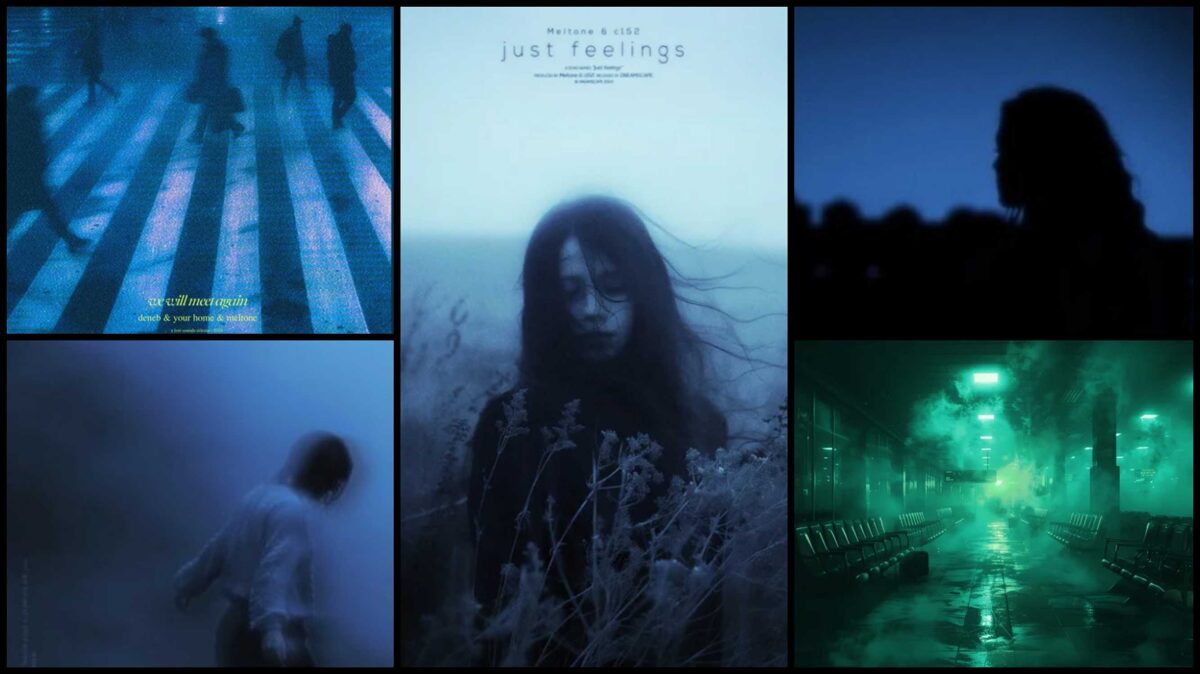
For the following and, up to today, Meltone would begin to release several songs, of course, mainly standing out with his ambient music singles. “A Better Place” (4.2/5), one that caught my attention, stood out more than its predecessors; the structure of the music combines excellently with the bass, giving it that melancholic touch. Now, Meltone also showed us that he could make good Lo-Fi music, having a Christmas track “Colder Than Ever” (5/5) — I loved listening to it, the melody is so pleasant and it cheered me up, it’s very relaxing and the vibe is great. But that’s not all, starting in 2024, he would upload “December Evening” (4.5/5), a Lo-Fi song that also has an ambient music version (3.8/5); there you can clearly notice a difference in how a Lo-Fi track and an ambient one sound. It’s worth noting that this varies depending on the artist, but anyway.
Weeks later, Meltone, together with Jara, another musical artist, released "Yesteryear" (3.9/5), a single that stands out mainly for its excellent melodic notes. Returning to dark ambient music, from my critical perspective, there is a lot of music by this artist that stands out for its meaningful melodies, representing this musical subgenre in an ambitious way. In a series of surveys, I asked Meltone what led him to move from making electronic music to creating ambient melodies. He responded as follows.
I have always liked the ambient parts in music, for example, the great soundscapes in bass or piano arrangements of EDM songs. Then I realized that there was a completely different genre for that type of music and I began to explore ambient. The album "Secret Life" by Fred, again... and Brian Eno was also a great inspiration to start creating ambient.
Meltone is an example that it is better to do what we like the most. After trying several subgenres of electronic music, he managed to find his best musical style.
It was never intended to be that way
On June 7 of this year, in collaboration with "your home," another ambient music artist, they released "It was never wanted to be" (4.4/5) on streaming platforms, an album consisting of 7 songs that stand out. Mainly, a guitar melody that flows excellently throughout the album. Starting moderately but with a good ending, as mentioned earlier, his guitar is the special touch, with Widx as guests. And for Coffee Stain, teamwork is represented in this album; clearly, there are some singles that have their issues but only affect them minimally. The songs that stand out the most are "Noche lluviosa" (5/5), "Sentimiento familiar" (5/5), and "Watching the stars together" (4.5/5).Making that album was an incredible experience. We were constantly talking on Discord and coming up with new ideas every day. We also decided to collaborate with different guitarists to give our dark ambient a fresh and more organic feel. We are both very happy with the album.
Meltone has a great future as an ambient music artist, and I hope so. One of the questions I asked was: What advice would you give to an artist who is just starting out? Responding with the following.
Create what you want to make. You can only create authentic music if it comes from yourself. Don’t try to meet other people’s expectations with your music.
If you stayed until the end, let me know your opinion in the comments box, don’t forget to follow me on Instagram and subscribe to my YouTube channel.
Ukiyo no Kiroku: Icey Wavs

Hello my friends, how are you? In this segment titled "Ukiyo no Kiroku" I will be showing you a specific Lo-Fi music artist so that you can get to know him better and whether you like to know more about your favorite Lo-Fi musician, or in case you want to know more about a new artist. or unknown to you and that has caught your attention, to get to know it better. Now, in order to write this blog about an artist, I mainly have to start a conversation (or something like that) where I started sending him a series of questions, after he agreed to answer obviously, and after answering them all, That's where I come in and start writing down what you're reading.
Icey Wavs is an artist who is currently anonymous, at his request, his musical origins (on streaming platforms) began in 2018 when he uploaded his first EP on August 3, titled “Melancholy Time Sung in Tea Trolley Lime” (3.7 /5) using the vocal samples of Shiloh Dynasty, if you want to know who this artist that I just mentioned is, let me tell you that 25% of the population of planet earth does not know his whereabouts and the other 75% do not. I don't even have the slightest idea who he is, anyway, he returns with the Icey Wavs EP, which consists of 5 singles, with "Sorrows" (4/5) being the single with the most plays on his Spotify profile, specifically a few 4.5M. reproductions. A curious fact is that when I asked him about the EP he told me that he didn't want to talk about it because he thinks "Melancholy Time Sung in Tea Trolley Lime" is bad, I'll leave it there for you, and Icey, if you see this you won't know. worry, mistakes make people strong, now leaving the sarcasm for a moment, in my opinion it seems like a good start as an artist, of course, it would also have been good if he used the Shiloh Dynasty samples in one or another song that he considers necessary, and in others they were Lo-Fi instrumental songs.
The beginning of the real icey wavs
As of 2019, she would release only two singles, "Morning Aura" (3.7/5) which consists of 3 songs and "For The Time Being" (4.1/5) which consists of only 2 (yes, I said single to two EPs, This is because certain streaming platforms consider the term "EP" to be an album of between 4 to 6 singles, a fact that you didn't know, right?), then in the last quarter of 2020 what I would call "The beginning of the real Icey Wavs", I say it that way because that year would be the time for Icey Wavs to continue growing as a musical artist, yes, what I'm telling you sounds a bit simple, but as an independent artist I tell you that you always have to try different light bulbs, In the end one of these will shine. In the questionnaire when I asked (pardon the redundancy) icey wavs about how he started making music, and what made him go down the path of it?, he answered the following: I became an artist because I I love creating things! It's a simple answer, but that's how I feel! Let me tell you that you consider "art" a stain on the floor, believe it or not, I was left with more doubts than answers, but nothing that the second question I sent him couldn't fix, which was Why Lo-Fi music , what made you make that type of music?, here icey wavs answers the following: I started creating lofi music because I felt that lofi was a perfect combination of many things I enjoyed, like anime, books and movies! For me it is more than just music and the community is also very friendly!OF COURSE WE ARE FRIENDLY! To finish with this quote, I tell you that icey wavs is one of the few artists who has always supported me and given advice in my journey as an artist and despite that I am glad that every day he is growing as the good musician that he is.
I'M GOING TO SKIP TWO YEARS! In 2022 I would upload, together with the artist Exmaxhina, "Desilusional Waves" (4.5/5), a single which would be released by the Tsunami Sounds record label, this is how I met his music and I also met him to him on Instagram, this rather peculiar single with a good vibe was one of my favorites. Now, single after single, icey wavs went on to have many collaborations with many artists and many record labels, the most notable being: 1am in the loop, kBeats, Taki Brano, Yotsugi, Nessen, nate2timez, Mr. Donsai, MyceliumBug, among others . (Sometimes I wonder, what did these artists think when choosing their nicknames?).
ガシャポン
Actually in 2023 my person disappeared from planet Earth without leaving any trace, so I was quite astonished when I heard ガシャポン (4.2/5), When I heard what?, in its translation it is called "Gashapon", these are a variety of toy capsules dispensed in vending machines and that are very popular in Japan, as you see on the cover of the EP, in the questionnaire icey wavs quotes the following: My EP ガシャポン is an experimental lofi EP I made with my good friend Konda Unstruct! I usually make very general lofi music, so it was a lot of fun making this experimental EP and it was amazing to see such unique work on streaming platforms.Wow, as you read above, ガシャポン is an experimental Lo-Fi EP that, from my point of view, I LOVED! It's incredible how the singles become so unique individually, my favorite is Usagi Yojimbo (5/5) this song is executed perfectly, the truth is it is an incredible experience and I would like to see more collaborations between these two artists, here I go. to quote something Icey Wavs told me:My best collaborations? My EP with Konda is definitely there, but I have more collaboration albums on the way with very good friends! They are definitely my best, but I will reveal more information about them soon!
Maybe I took it out of context, but if there is another collaboration with Konda, I WILL BE INFORMING YOU THROUGH THIS BLOG! Also, new releases from these artists are coming.Year 2024, a few months ago icey together with 1am in the loop, uploaded "Gentle Stream" (5/5) to streaming platforms, which in case you ask me, is one of the best songs I have heard from these artists, I think . I like the vibe it generates, and you can see the evolution it has had over the years, I was curious to know if Icey Wavs was going to release a 10-song album, since they always release singles or EPs, but maybe one Will. Have we ever had an album by these artists? That's what I more or less asked him, to which he replies:
I'm making some albums right now with some of my good friends! I can't talk more about them, but stay tuned!
Now, instead of answering all my questions, he let me know more, since I don't know if this was an eight, ten or even 15 song album in development, or just referencing other EPs, I don't know. I don't know, we'll have to wait, apart from the fact that when I asked him what his favorite song was?, he responded that it was one that would be released very soon on streaming platforms titled “Nocturne” (?/5), with 1am on the loop as a collaborator, a combination that also works personally.To close, I leave you a quote from icey wavs in which he answered the question: What advice do you give to independent and future artists who are yet to come?:
My advice to artists is to be adaptable! Don't be afraid to experiment and try different genres! You want to have your own basic style, but you also don't want to lock yourself in one place!
If you stayed until the end, thank you very much for reading this article, don't forget to leave me your opinion and if you want to know about another Lo-Fi artist that is of interest to you, let me know in the comments. box and also follow me on my social networks, especially Instagram and YouTube, here I say goodbye.